Client Portal for Home Service Businesses
Home service businesses say they want great customer service. Then, naturally, they make customers dig through old email threads to find a quote, an invoice link, and the latest appointment details. It is not cruelty. It is disorder. And disorder always invoices you back, first in delays, then in lost revenue.
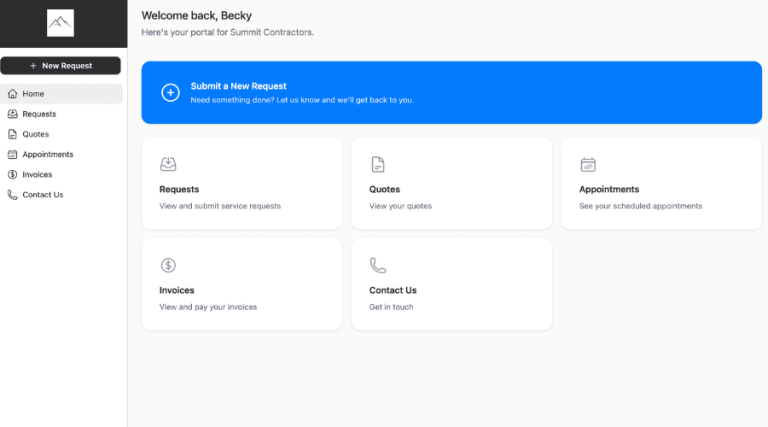
The BlueSuite Client Portal fixes that. It gives customers a branded customer portal where they can request work, approve quotes, pay invoices, and review appointments in one place. In other words, it respects how customers actually behave. As a result, you get faster decisions and faster cash.
Customers already self serve, so make it easy
Let’s be clear about what’s happening here. Customers are not hard to reach. They are busy. They want the quickest path to resolution, so they try to handle things themselves before they ever call your office.
Harvard Business Review puts data behind the obvious: “Across industries, fully 81% of all customers attempt to take care of matters themselves before reaching out to a live representative.”
That is the reality reminder. A portal is not a gimmick. It is a practical response to customer behavior. When you give people a clean path to take action, they take it. Then work moves.
What customers can do in the customer portal
A portal is only valuable if it removes friction at the exact moments that slow revenue down. Therefore, the experience needs to make the next step obvious, not buried.
Submit service requests with less confusion
Customers can submit a service request directly through the portal. Because the request enters your workflow in a structured way, you reduce the classic problems: vague emails, missed voicemails, and incomplete details. As a result, you respond faster. More importantly, faster response converts more requests into scheduled work.
Review and approve quotes without the “just checking in” loop
Quote approvals are where many jobs stall. Not because the customer is malicious, but because your process makes procrastination easy. The portal gives customers one place to review line items, see totals clearly, and accept or decline. Consequently, you spend less time chasing decisions and more time executing paid work.
Pay invoices quickly, with payment options customers recognize
Payment speed is often framed like a personality issue. It is not. It is a process issue. When payment is easy, payment happens sooner.
Stripe’s documentation is direct about a key option many customers prefer: “ACH … lets you accept payments from customers with a US bank account.”
That matters because choice reduces hesitation, especially on larger invoices. In addition, it cuts down the quiet time drain of “Can you send me a different link?” messages.
View and manage appointments without scattered messages
Customers can view upcoming appointments and request changes in one place. Instead of appointment details living across texts and emails, the portal keeps the schedule anchored to a single source of truth. That’s not just convenient. It is operational order. And order prevents the small scheduling mistakes that turn into bigger customer frustrations.
Why self service is a best practice, not a shortcut
Some businesses treat self service like a way to avoid customers. That is the wrong frame. Self service is not neglect. It is clarity. It gives customers the dignity of handling routine tasks without waiting on someone to respond.
Gartner captures the broader direction of customer operations: “Live chat, self-service portals, and knowledge management systems are solidifying their place as essential tools for fast, scalable support.”
Here’s the point. If you want to grow without letting admin work rot your margins, you need systems that scale. A client portal is one of those systems because it prevents routine questions from becoming routine interruptions.
Make login easy, or adoption dies quietly
A portal can be beautifully designed and still fail if signing in feels like a chore. Of course, the same businesses will later claim “customers don’t use portals,” when the real truth is simpler: customers don’t use painful systems.
BlueSuite uses magic link login to keep access straightforward. Customers enter their email address, receive a secure sign in link, and click to log in. No password to remember. No reset loop. No unnecessary friction.
On the broader theme of simpler sign ins, Microsoft notes: “Passkey sign-ins are eight times faster than a password and multifactor authentication.”
Different technology, same lesson. Faster access increases adoption. Then adoption produces the outcomes you actually care about.
The business payoff: more booked work and faster cash
When customers can take action immediately, the timeline compresses in your favor. Quotes get approved sooner. Appointments get scheduled sooner. Invoices get paid sooner. Meanwhile, your team spends less time digging through threads and more time doing work that actually matters.
Let’s be clear about the moral of the story. Order is not aesthetic. Order is profitable. It respects customers’ time and protects your own. Decay is what happens when you keep pretending scattered communication is “personal service,” while your cash flow waits on an email chain from three weeks ago.