Highest Paying Blue Collar Jobs in 2026
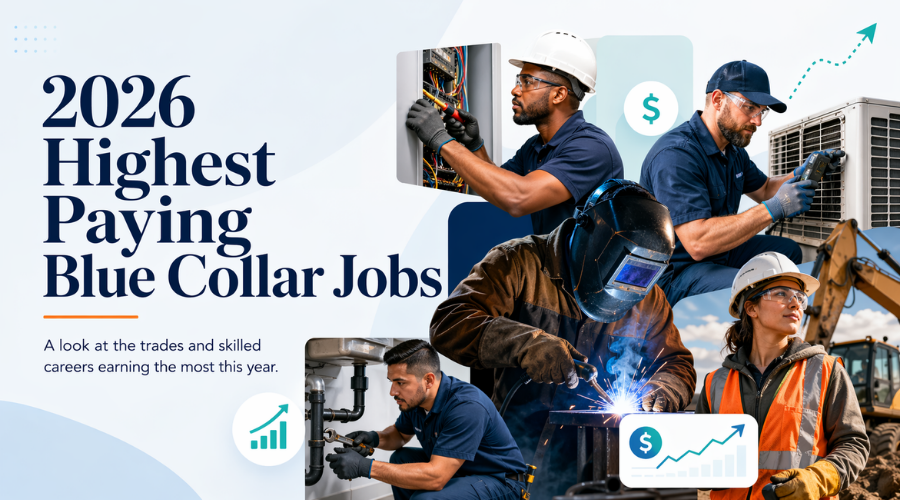
Blue collar jobs can offer strong pay, steady demand, and real long-term upside without the standard four-year-degree path. In particular, skilled trades like electrical, plumbing, HVAC, and elevator repair continue to stand out for earnings, stability, and business ownership potential. Based on the latest U.S. Bureau of Labor Statistics data, many of these roles pay well above the median wage for all occupations.
Quick answer: what are the highest paying blue collar jobs?
Some of the highest paying blue collar jobs in the U.S. include construction managers, elevator and escalator installers, power-line workers, aircraft mechanics, stationary engineers, boilermakers, electricians, plumbers, wind turbine technicians, and HVAC technicians. Overall, median pay for these roles ranges from $59,810 to more than $106,000, depending on the trade.
Top 10 highest paying blue collar jobs
1. Construction Managers
Construction managers plan, coordinate, budget, and supervise projects from start to finish. As a result, they oversee schedules, crews, subcontractors, materials, and site progress.
Salary & earnings: The median annual wage for construction managers is $106,980.
Training requirements: In most cases, construction managers need a bachelor’s degree. However, many also build experience in the field before moving into management.
Job demand: Demand remains solid because commercial, residential, and infrastructure projects all need planning and oversight.
Working conditions: Construction managers usually split time between an office and active job sites. Because of that, the work can involve long hours, deadlines, and constant coordination.
2. Elevator and Escalator Installers and Repairers
These workers install, maintain, and repair elevators, escalators, moving walkways, and other lift systems. In addition, the work combines mechanical and electrical troubleshooting.
Salary & earnings: The median annual wage for elevator and escalator installers and repairers is $106,580.
Training requirements: Most workers enter the trade through an apprenticeship. In many states, licensure is also required.
Job demand: Employment is projected to grow 5% from 2024 to 2034, with about 2,000 openings per year on average.
Working conditions: On the job, workers may deal with confined spaces, heights, machine rooms, emergency repairs, and overtime.
3. Electrical Power-Line Installers and Repairers
Power-line workers install and repair the cables, wires, poles, and towers used in electrical transmission and distribution systems.
Salary & earnings: The median annual wage for electrical power-line installers and repairers is $92,560.
Training requirements: Typically, workers need a high school diploma or equivalent, plus technical instruction and extensive on-the-job training. Apprenticeships are common as well.
Job demand: Employment is projected to grow 7% from 2024 to 2034, with about 10,700 openings per year on average.
Working conditions: This is one of the toughest blue collar jobs physically. For example, workers often operate outdoors, at height, and sometimes in storm or emergency conditions.
4. Aircraft Mechanics and Service Technicians
Aircraft mechanics inspect, maintain, troubleshoot, and repair airplanes and related systems. Because of that, their work is critical to safety and reliability.
Salary & earnings: The median annual wage for aircraft mechanics and service technicians is $78,680.
Training requirements: Most workers complete postsecondary training, often through an FAA-approved program. In addition, certifications are typically required.
Job demand: Employment for aircraft and avionics equipment mechanics and technicians is projected to grow 5% from 2024 to 2034, with about 13,100 openings per year on average.
Working conditions: The work takes place in hangars, repair stations, and on airfields. Meanwhile, schedules can include nights, weekends, and physically awkward repair tasks.
5. Stationary Engineers and Boiler Operators
Stationary engineers and boiler operators run and maintain boilers, chillers, turbines, pumps, compressors, and other major building systems.
Salary & earnings: The median annual wage for stationary engineers and boiler operators is $75,190.
Training requirements: Entry usually requires a high school diploma or equivalent plus extensive on-the-job training. Depending on the employer or location, licensing or certification may also be required.
Job demand: These roles remain important in hospitals, schools, industrial facilities, and large commercial buildings that rely on central mechanical systems.
Working conditions: Most of the work takes place in mechanical rooms or industrial environments. As a result, workers may monitor systems, rotate shifts, and respond to equipment issues.
6. Boilermakers
Boilermakers assemble, install, maintain, and repair boilers, closed vats, and other large containers that hold liquids or gases.
Salary & earnings: The median annual wage for boilermakers is $73,340.
Training requirements: Most boilermakers learn through an apprenticeship. During training, they usually develop skills in welding, blueprint reading, rigging, and jobsite safety.
Job demand: Boilermaker employment is projected to decline 2% from 2024 to 2034. Even so, BLS still projects about 800 openings per year on average.
Working conditions: This is physically demanding work and may involve travel, heavy lifting, confined spaces, and industrial jobsites.
7. Electricians
Electricians install, maintain, and repair electrical power, lighting, communications, and control systems in homes, businesses, and industrial buildings.
Salary & earnings: The median annual wage for plumbers, pipefitters, and steamfitters is $62,350.
Training requirements: Most electricians train through apprenticeships, though some begin in trade school. After that, most states require licensure.
Job demand: Employment is projected to grow 9% from 2024 to 2034, with about 81,000 openings per year on average.
Working conditions: Electricians work indoors and outdoors on construction sites and service calls. Depending on the job, the work can involve ladders, crawl spaces, and live systems.
8. Plumbers, Pipefitters, and Steamfitters
These tradespeople assemble, install, and repair piping systems that carry water, steam, gas, and other liquids. In residential markets, plumbing remains one of the most durable local-service trades.
Salary & earnings: The median annual wage for plumbers, pipefitters, and steamfitters is $62,970.
Training requirements: Most people enter through an apprenticeship, although some start in vocational school. In addition, most states require plumbers to be licensed.
Job demand: Employment is projected to grow 4% from 2024 to 2034, with about 44,000 openings per year on average.
Working conditions: The work can be physical, dirty, and unpredictable. Furthermore, many plumbers are on call for emergencies.
9. Wind Turbine Technicians
Wind turbine technicians inspect, maintain, diagnose, and repair turbines used in wind energy generation.
Salary & earnings: The median annual wage for wind turbine technicians is $62,580.
Training requirements: Most attend technical school and then receive on-the-job training focused on mechanical, electrical, and hydraulic systems.
Job demand: This is the fastest-growing occupation on the list. Specifically, projected employment growth is 50% from 2024 to 2034, with about 2,300 openings per year on average.
Working conditions: The work is physically demanding and often done at height, outdoors, and in changing weather conditions.
10. HVAC Technicians
HVAC technicians install, maintain, and repair heating, ventilation, air conditioning, and refrigeration systems in homes and commercial buildings.
Salary & earnings: The median annual wage for heating, air conditioning, and refrigeration mechanics and installers is $59,810.
Training requirements: Most HVAC technicians complete a postsecondary certificate or similar training program. From there, they build skills through hands-on experience, and some roles also require licensing or certification.
Job demand: Employment is projected to grow 8% from 2024 to 2034, with about 40,100 openings per year on average.
Working conditions: HVAC work can be physically demanding and seasonal. For instance, technicians often work in attics, basements, rooftops, and outdoor conditions.
All salary figures below are based on May 2024 wage data released in 2025 by the U.S. Bureau of Labor Statistics.
Entry-level vs. experienced pay in blue collar jobs
One of the best things about blue collar jobs is that pay can rise meaningfully with experience. At first, entry-level workers often earn below the median. Over time, however, licensed specialists, experienced technicians, supervisors, and business owners can earn much more. That pattern is especially clear in electrical, plumbing, and HVAC, where skill, speed, specialization, and customer trust directly affect earnings.
Best blue collar jobs for technicians
If your goal is to become a highly paid technician, several options stand out. For example, elevator repair, power-line work, aircraft maintenance, electrical work, and HVAC all offer strong upside. Elevator mechanics and power-line workers stand out for pay. On the other hand, electricians and HVAC technicians usually offer a more accessible entry path with steady long-term demand.
Best blue collar jobs for small business owners
Not every blue collar job turns into a scalable local business. Even so, electrician, plumber, and HVAC technician are usually the strongest blue collar jobs for future small business owners. These trades benefit from recurring service demand, repair and replacement work, local customer relationships, and business models that scale well with better scheduling, dispatching, quoting, and invoicing.
Final thoughts on the best blue collar jobs
The best blue collar jobs are not always the ones with the single highest salary. Instead, the better question is which job gives you the best mix of pay, demand, accessibility, and long-term upside. For pure pay, construction managers and elevator installers are near the top. For growth, wind turbine technicians stand out. Overall, for a strong all-around path, electricians, plumbers, and HVAC technicians remain some of the best blue collar jobs in the country.